From OpenClaw to Hyperagent: What Actually Changes
Hyperagent has everything your OpenClaw setup was trying to do, without the burden of running the infrastructure underneath it.

If you've got an AGENTS.md you've been refining for weeks and a MEMORY.md your agent actually relies on, you know what it costs to build that context. You also know how fast one bad OpenClaw update can bring it all down.
Updates that break your setup. Memory that wipes without warning. A heartbeat you can't fully trust.
We talked to many OpenClaw users and asked them what their experience was actually like. Their answers were consistent: the thing wearing them down wasn't a missing feature. It was the maintenance.
"[In OpenClaw] a surprising amount of time gets spent maintaining the agent itself instead of using it. Fixing installs, debugging updates, recovering broken workspaces, tweaking configs... figuring out why something that worked yesterday stopped working today. The value isn't that Hyperagent does more — it's that it lets me spend more time solving problems and less time maintaining the tool that's supposed to solve them."
Sachin — runs OpenClaw regularly, built multiple agents, now uses Hyperagent in his stack
If that sounds familiar, read on.
What Hyperagent Is (and Isn't)
Hyperagent has everything your OpenClaw setup was trying to do, without the burden of running the infrastructure underneath it.
Who runs it
In OpenClaw, you run your agent on your machine. You wrote the files, wired up the tools, kept the schedules running, and fixed it every time something broke.
Hyperagent runs as a managed cloud platform. That means persistent runtime, tools stay connected via secure OAuth, and when we push an update, your configuration, your memory, and your workflows are untouched. No maintenance window. No broken setup on a Monday morning.
"I spent days just to harness OpenClaw well enough to command more complex workflows. Updates were a real headache, things would change without any heads-up. Hyperagent is less about harnessing the system and more about building, which I like."
Eric — regular OpenClaw user, built multiple agents, now using Hyperagent
What your agent remembers
In OpenClaw, memory is a flat file your agent re-reads from your workspace each session. It accumulates cruft over time, and one bad update can wipe it entirely. Your agent wakes up not knowing what it knew yesterday.
"OpenClaw memory is fully broken. I tried all kinds of solutions: self-hosted, VM-hosted, managed-hosted ones. I can assure you that even after trying all that, the Reddit forums are still discussing how to sort the memory. I spent a lot of money on OpenClaw because it was phenomenal to suddenly give it access to the entire file system and work, but it took too much time to make it work for me."
Santosh — regular OpenClaw user, built multiple agents, now uses Hyperagent
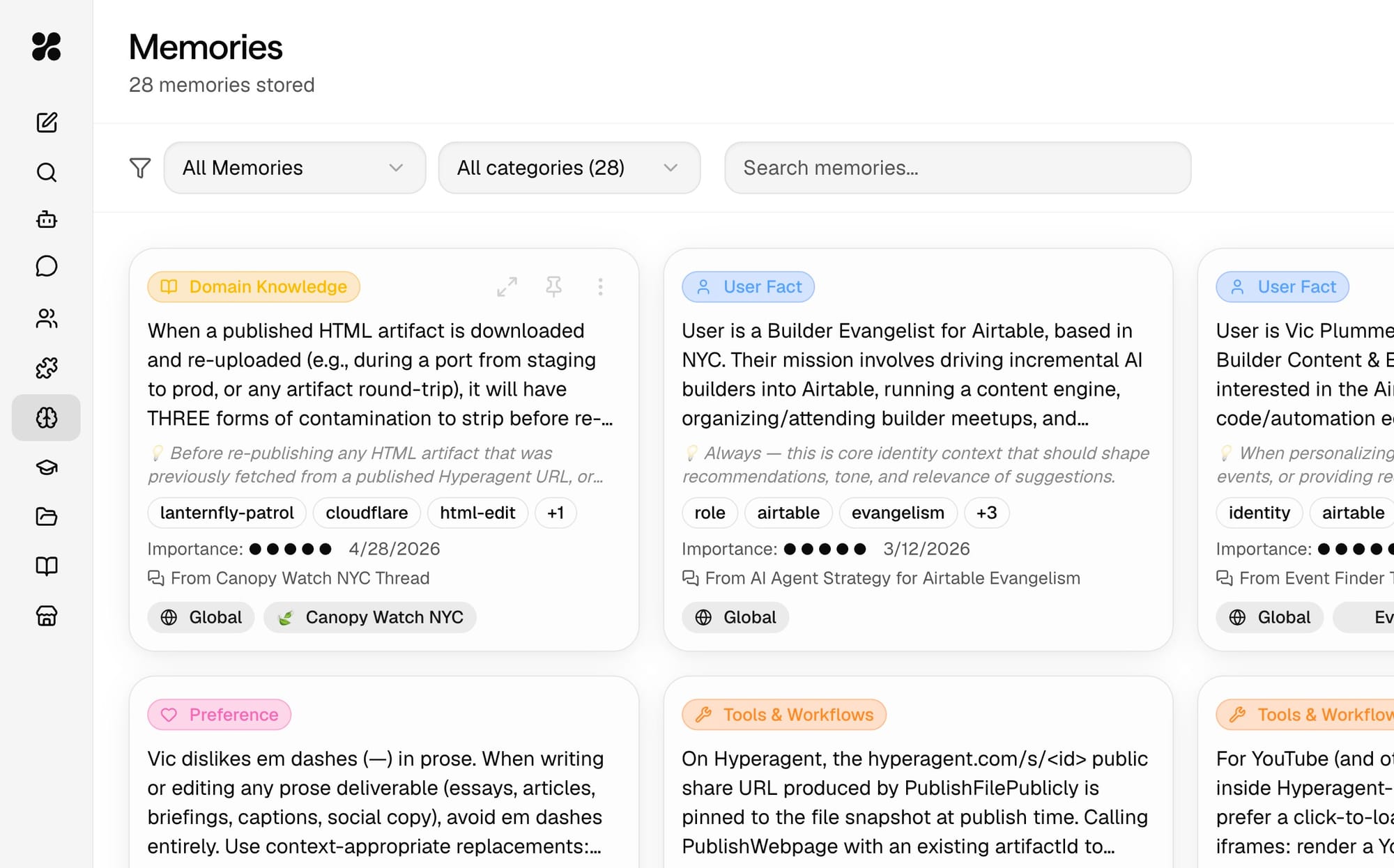
In Hyperagent, memories are persistent and scored by importance. High-importance entries load automatically in every conversation; lower-importance ones surface when relevant. You decide which agents have access to which memories, and context accumulates over time instead of disappearing overnight.
"As projects get larger, repeatedly re-explaining context becomes a real pain. Good memory compounds over time and makes long-running projects feel much smoother."
Sachin
What your agent can actually do
In OpenClaw, TOOLS.md declared what tools existed. Your agent knew about them, but the connection was only as reliable as your config.
In Hyperagent, integrations are live OAuth connections. Your agent reads your calendar, drafts in Gmail, updates Linear. It acts; not just knows. And schedules are real cloud triggers that fire on time whether your laptop is open or not.
You're Still in Control
Moving to Hyperagent doesn't mean handing your agent off and hoping for the best.
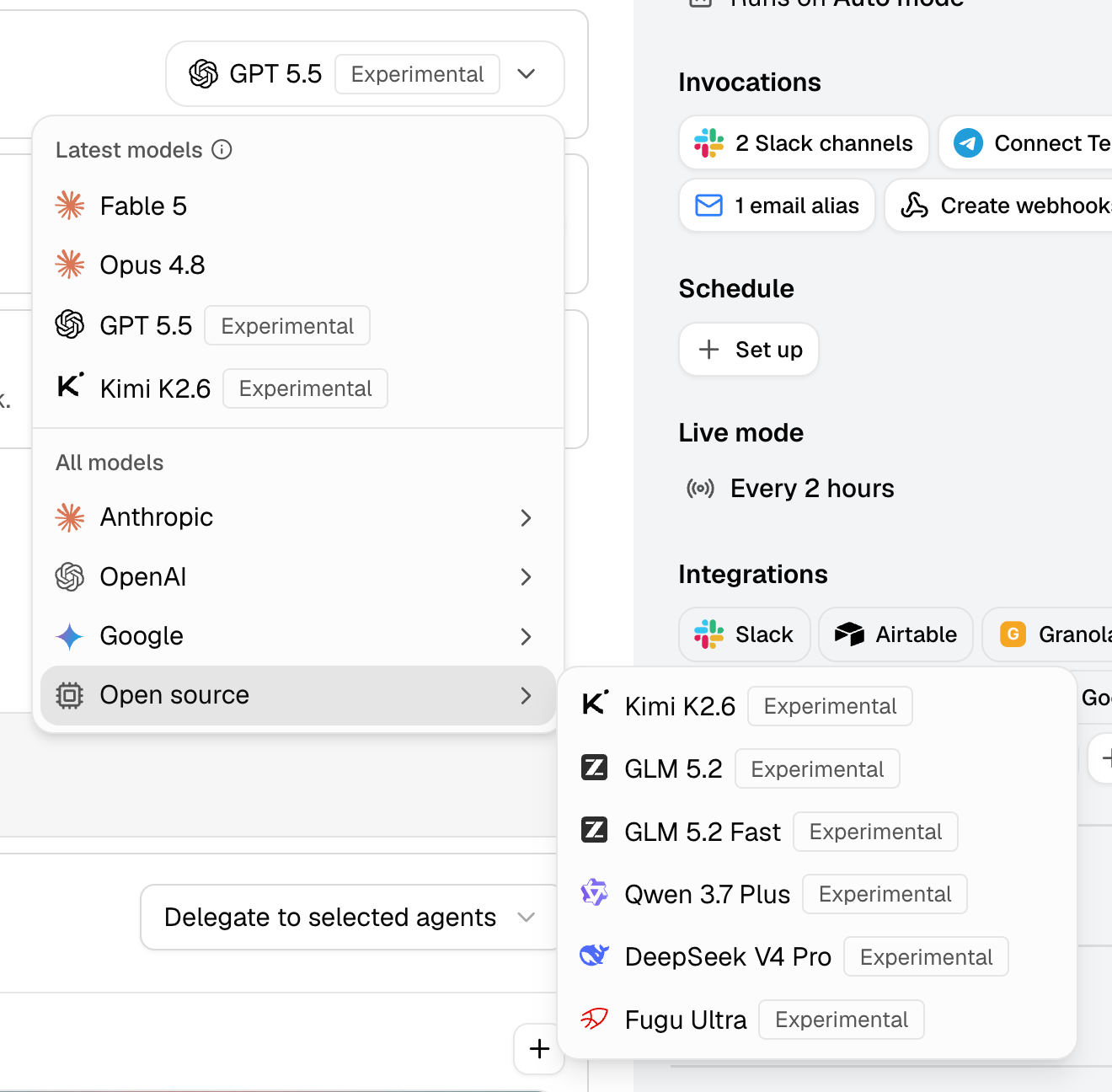
You pick the model. Want to run on Fable 5, or choose a cheaper open source model? You choose which model each agent uses, and you can change it anytime.
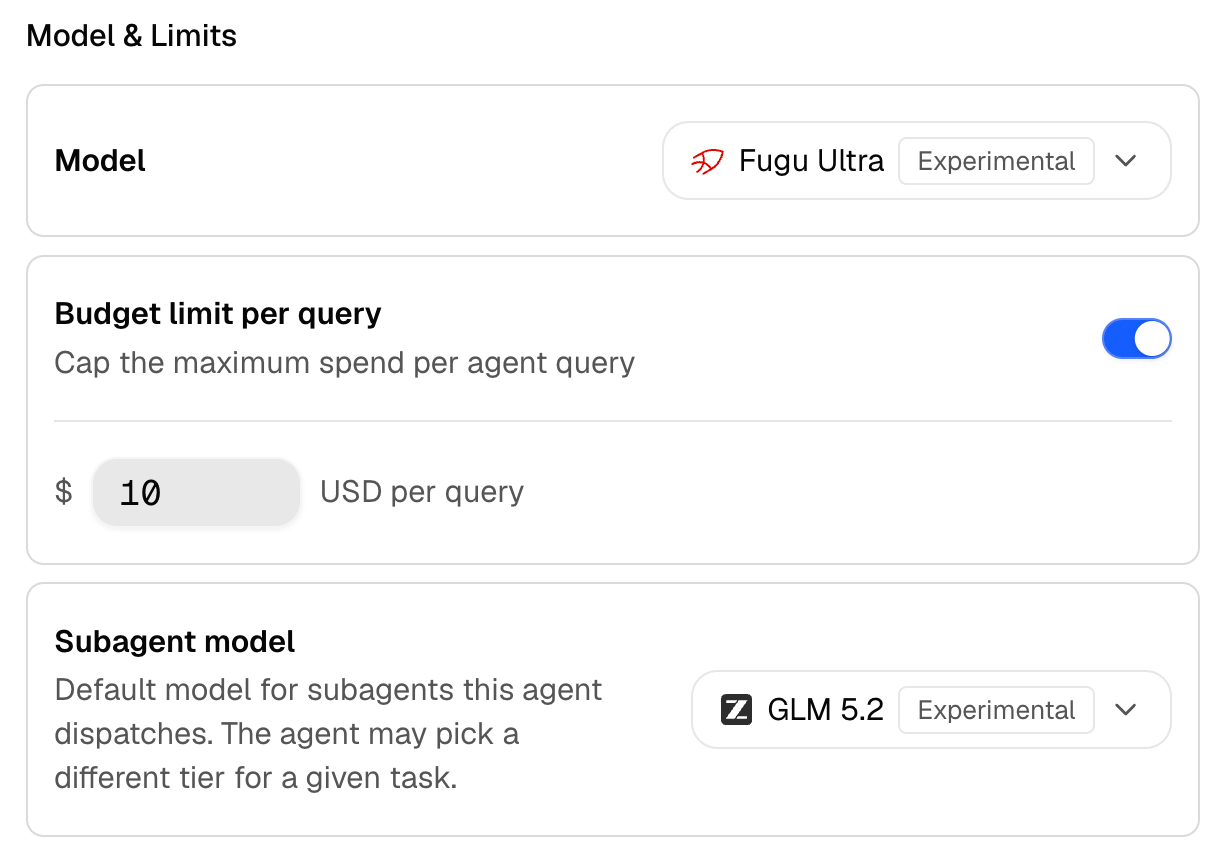
You set the budget. Every agent has its own spend cap; no surprise bills, no runaway tasks, no "what did it do all night." You decide how much each agent is allowed to spend, and it can't go over.
You read the logs. Every action your agent takes is recorded. What it did, what tools it called, what it decided and why. If something looks off, you can see exactly where it went.
You still get own the config. Tune the prompt, adjust the tools, update the memory. It's all editable, all the time.
The difference between OpenClaw and Hyperagent isn't that you lose the controls. It's that you're not also the one building and maintaining the engine underneath them.
Is It Right for You?
Most of the users we talked to aren't fully off OpenClaw yet. They're running both. That's a reasonable place to start.
"Try Hyperagent on one real workflow, not a toy demo. If the goal is productizing agents, creating scheduled outputs, building client-facing workflows, or connecting multiple content and research systems, Hyperagent is very strong. If the goal is deep local control over runtime, memory files, routing, and credentials, keep OpenClaw running until Hyperagent proves it can preserve that control."
An OpenClaw & Hyperagent user — built a fully invested agent with custom memory and skills, now split between both platforms
Their caveat on sprawl is worth sitting with, one user notes: "Without governance, Hyperagent can accumulate duplicate memories and overlapping skills quickly." This is a real challenge with any agent platform, and honestly with OpenClaw too, where MEMORY.md bloat is a known headache. The difference in Hyperagent is that you have the tools to manage it: memories are visible, editable, and deletable from one place. Sprawl happens when there's no governance, and Hyperagent gives you a place to govern.
"I think OpenClaw people are more like Linux people. They actually enjoy tinkering. For serious people focused on productivity, Hyperagent is a major winner."
Peter — used OpenClaw as a daily driver for a full multi-agent setup, now runs both platforms for different things
The switching cost feels real. You've built something that works, and no one wants to find out mid-migration that their context didn't survive the move. One user who ran a full multi-agent setup on OpenClaw and is now fully on Hyperagent, echoed this same pattern for making the switch: broken updates, unreliable memory, too much time spent on maintenance. The pattern is consistent enough to be worth taking seriously.
The Migration Takes About Five Minutes
If you're ready to try it on a real workflow, the import process is fast. Usually around five minutes depending on your setup.
Hyperagent reads your workspace and maps each file to where it lives natively: your SOUL.md and AGENTS.md transfer verbatim into the system prompt, your MEMORY.md gets split into scored entries, your HEARTBEAT.md becomes real cloud schedules, and your TOOLS.md maps to live integrations — with a clear breakdown of what's ready, what needs a quick OAuth connection, and what's been replaced by a native equivalent.
Nothing gets rewritten or summarized. What you built comes with you.
Ready to see how your setup maps over?