Brokers Used to Spend Hours Generating Documents. Now they Spend those Hours with Clients.
A 40-person insurance brokerage built 11 AI agents in a week. The documents that used to eat their days now take minutes. What they're doing with the time back is the real story.

A 40-person insurance brokerage built 11 AI agents in a week. The documents that used to eat their days now take minutes. What they're doing with the time back is the real story.
Every insurance brokerage in North America runs on a broker management system. It generates documents, stores policy data, and tracks clients. It is the system of record. The ERP of insurance. There is no version of "being a brokerage" that doesn't include one of these platforms.
Davis Gilbert is planning to turn his off.
Not because it's broken. Because it solves the wrong problem. A broker management system assumes that the hard part is keeping data organized. But Davis watched his team and saw something else: skilled people, spending hours generating documents that follow a known process. A market submission takes a few hours of data entry plus a day of backlog. A full risk assessment is an all-day activity. Renewal proposals run four or five hours each. One team existed just to generate certificates of insurance.
The data was fine. The work that sat on top of the data: document generation, risk analysis, and compliance formatting was where his team's hours went.
So he built 11 agents on Hyperagent in about a week. And now he's watching the broker management system go the way of every enterprise tool that couldn't keep up: still running, increasingly unnecessary.
Summit has been building proprietary tech since 2022. Sherpa, an AI compliance platform, and Glide, a tool for internal quoting. The agents aren't a one-week experiment for Davis, they're the next move in a multi-year tech strategy.
The Process Is the Product
Davis opened a thread in Hyperagent and started describing how his brokerage works.
The agents weren't designed from a feature list. They were designed from process descriptions.
Davis would explain what a market submission from Summit requires: underwriting call notes, policy data, and contact information. Then he explained what it should produce, an executive summary, marketing rationale, and property schedules.
While building, Hyperagent asked clarifying questions. "Where does this data come from?" "What's usually missing?" "What does the output look like when it's right?" Along the way, he connected Hyperagent to HubSpot and BigQuery so the agents could read and write to the systems his team already uses.
Each conversation produced an agent. Each agent handles one thing the BMS used to do.
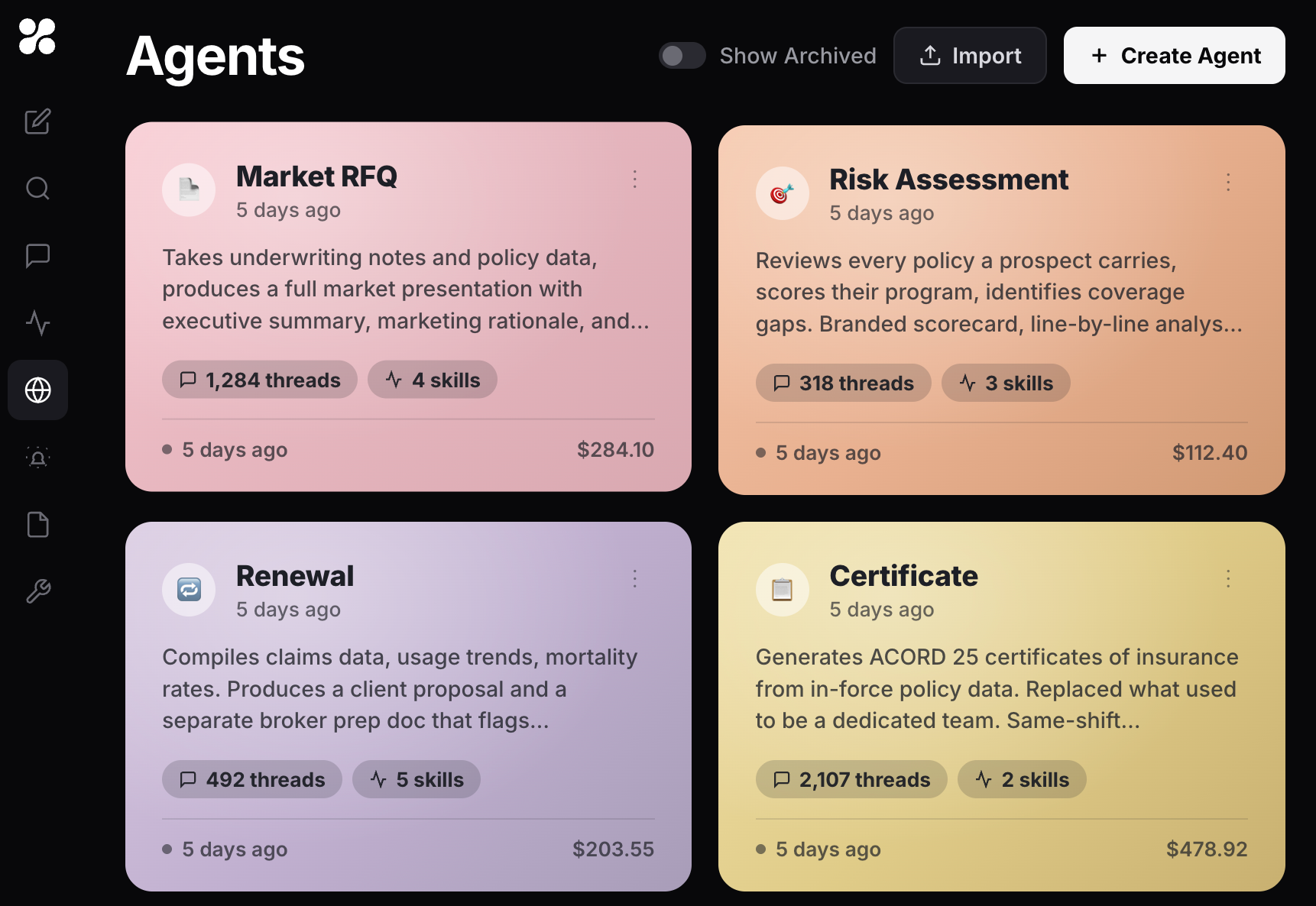
Eleven agents. One week of building. The daily output of each agent used to require multiple dedicated teams over weeks.
Handing Your Team a New AI Tool Doesn't Guarantee Results
Davis tried the obvious thing first. When Claude Co-Work launched in January, he gave everyone at the company a subscription. It didn't work.
Giving people a chat window is not the same as giving them a tool that fits into their existing process. Forty people with forty different prompting styles produce forty inconsistent outputs.
So Davis gave each agent its own Slack channel. Brokers interact in plain language. One broker typed a one-sentence request to the RFQ agent and got back a complete market submission. No prompting tricks. No template wrangling.
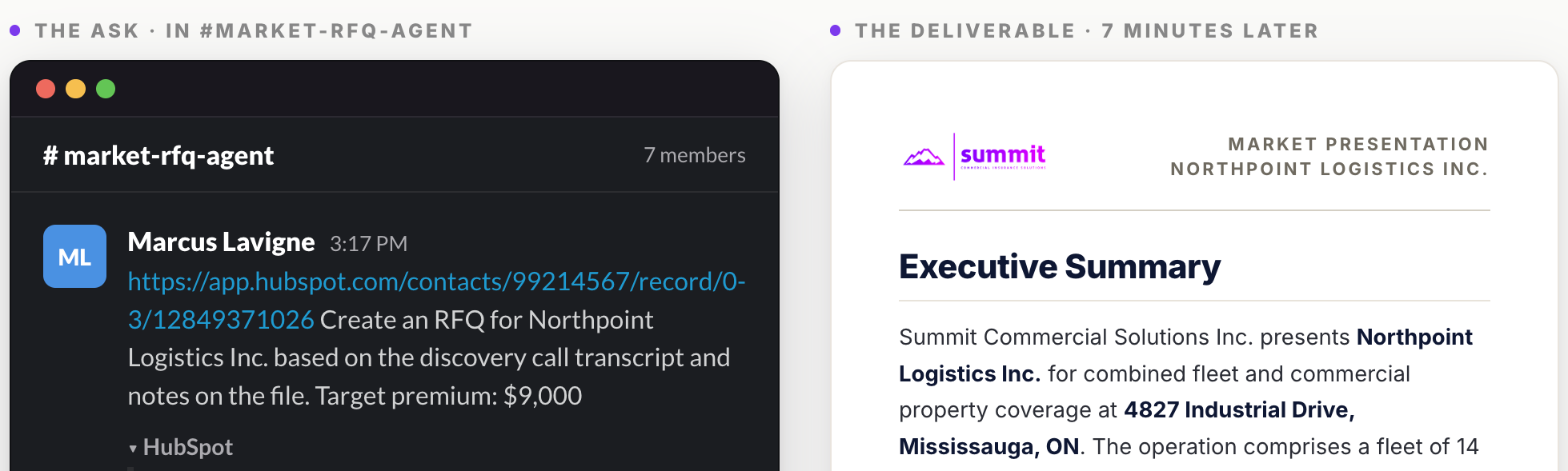
People came around when they saw the numbers. A deliverable requested in Slack, a four-hour manual task done in ten minutes, and the output was right.
Accuracy Is What Earns Trust. Memory Is What Keeps It.
When a broker corrects an agent's output, a formatting preference, a distinction between insurers, or a convention specific to Summit, it gets added to Hyperagent's memories. Next time, the correction is already applied. The agent doesn't repeat the same mistake twice.
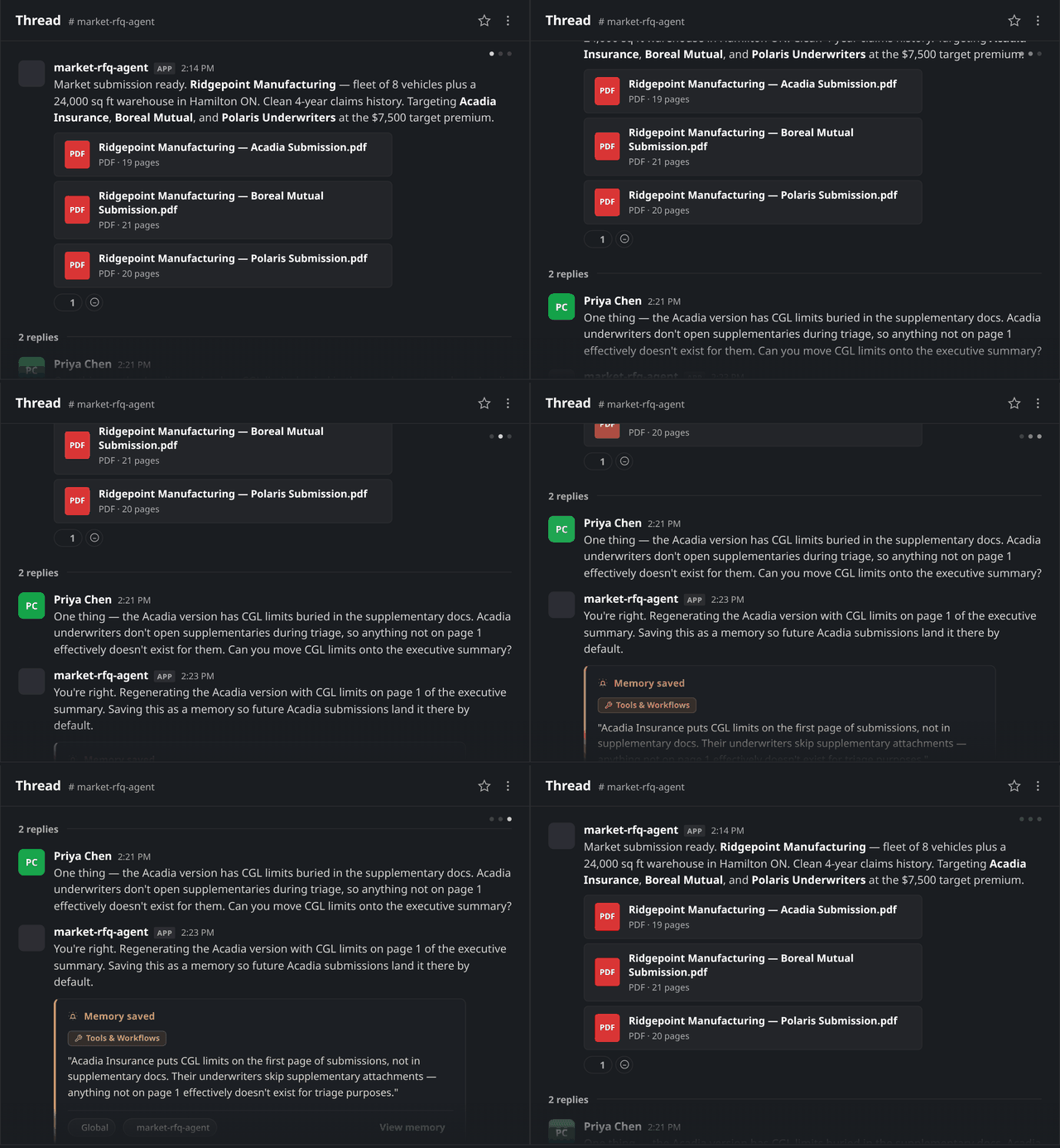
This is where agents stop acting as a productivity tool and start being an institutional knowledge system. The agents are learning how Summit Cover does things: which insurers prefer which formats, which fields matter in which provinces, and which clients have specific document requirements.
But Davis doesn't just let memories accumulate. He uses memory as governance. If a broker teaches the agent something Davis doesn't want persisted across clients, he overrides it. If the agent learns a distinction that applies universally, he lets it stand. He's the editorial layer on top of what the agents learn from forty different people.
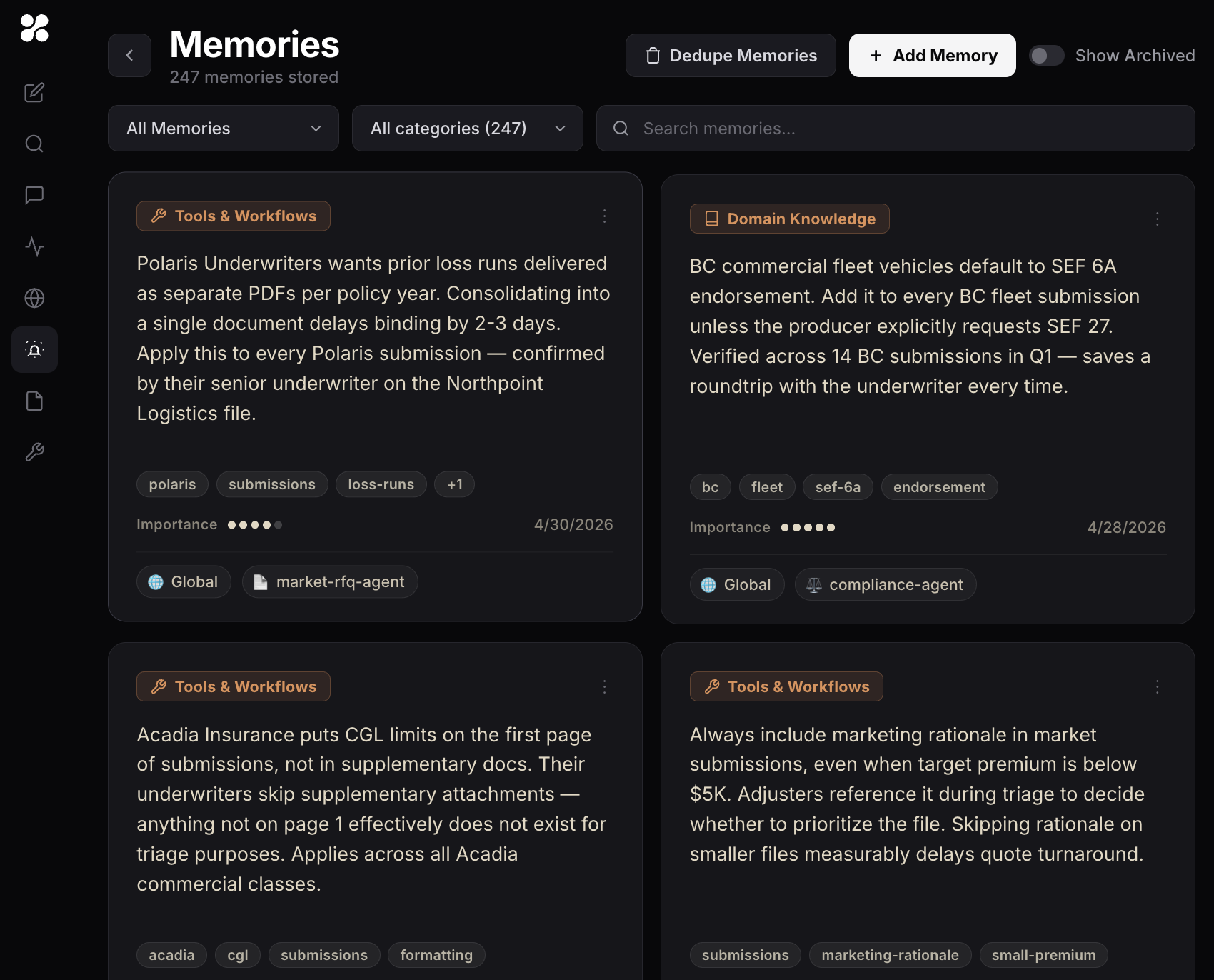
The institutional knowledge of how Summit Cover does things is building up inside Hyperagent, not inside people's heads.
What Happens When the Documents Handle Themselves
The policy scraper has been migrating data to BigQuery. The agents handle document generation. HubSpot manages the CRM layer. The broker management system is still running. But the list of things it does that nothing else can is getting shorter every week.
Davis is planning to turn it off "in the next month or two."
What he's building next makes the current fleet look like the foundation, not the destination. "I'm creating an orchestration layer," a single interface where requests route to the right agent automatically, instead of forty people knowing which Slack channel to use. He's creating background agents that run without anyone asking: comparing a received policy document against the original proposal, catching discrepancies before a broker notices. He plans on rolling out agents to handle the 12,000 renter insurance policies Summit manages.
The large brokerages are signing corporate AI agreements with model providers. That's their strategy: give people access to tools. Davis sees the gap. True integration takes an owner who knows the workflows, not an enterprise agreement. He gives the incumbents a year or two. "That's an eternity right now."
What This Actually Proves
Davis didn't replace his team. He replaced the software his team used to depend on. The brokers still review every document. They still own the client relationships. They still make the calls about coverage and risk. They just don't spend hours generating the artifacts those decisions require.
Broker management systems exist because generating insurance documents by hand is painful and error-prone. The solution to that pain was always "build a system that organizes the process." The agents take a different approach: build something that handles the process and delivers the outputs.
Start building your system of agents on Hyperagent