What is Hyperagent?
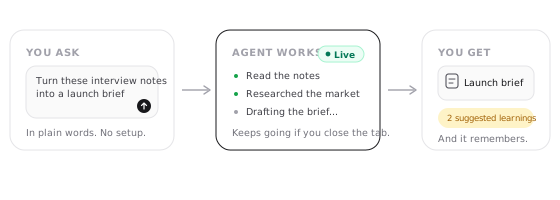
Your best work depends on context, judgment, and follow-through. Hyperagent gives agents the tools to understand your context and complete complex workflows on your behalf.
Key Takeaway
Hyperagent gives agents the context and tools to deliver amazing outputs in the places you already work.
To understand how that works, focus on Threads for where the work happens, Agents for context and judgement, and Learnings for improvement over time.
Threads, agents, and learnings
Threads: Where Work Happens
Start a thread, describe what you need, and the agent goes to work. When the work is done, the thread contains a complete history of everything that happened: research, data, drafts, and the final output.
Think of it as a working session with a capable collaborator equipped with tools that can search the web, browse pages, run shell commands, write and execute code, generate media, and call external APIs; all within a single conversation.
Agents: Persistent Identities You Build Over Time
An agent is a teammate you configure and improve. It has a name, instructions for how to work and make decisions, access to tools, and knowledge it can carry forward.
When you start a new thread with an agent, or the agent starts one itself, it brings that context with it. What you teach it in one thread can shape how it works in the next.
Learnings: Context Without Clutter
Learnings are how an agent improves over time.
As agents work, they can build up reusable instructions, remembered facts, and quality checks. Hyperagent keeps those learnings outside the active conversation, then pulls in what matters for the task at hand.
That matters because context windows are limited. The goal is not to make every thread bigger; it is to give the agent the right context at the right moment.
Later, we break learnings into Skills, Memories, and Rubrics. For now, think of them as the layer that helps an agent work more like your team over time.
How agents differ from chat tools
| Dimension | Chat tools | Hyperagent |
|---|---|---|
| Memory | Resets every session. Context never carries forward. | Agents carry memory across sessions. Context builds over time rather than resetting with every new conversation. |
| Tools | Can write text and sometimes browse the web. | Has access to integrations, code execution, browsers, and media. Acts inside your systems, not just alongside them. |
| Judgment | Waits for the user to orchestrate each step. | Breaks a goal into steps, decides what to do next, and follows through. You describe the outcome; the agent figures out the path. |
Key vocabulary
💬Thread
A single work session focused on one task. Within a thread an agent can browse the web, execute code, generate artifacts and more. When the work is done, the thread serves as a complete record of everything that happened as a self-contained record of work.
🤖Agent
A persistent identity with a name, role definition, tools, and accumulated knowledge. Agents carry their full configuration into every new thread and compound in effectiveness over time.
🧩Skill
A reusable capability an agent has learned: how to query a specific API, generate a report format, or execute a multi-step workflow. Skills are documented, repeatable, and transferable between agents.
🧠Memory
A fact the agent retains across sessions: your team's preferred report format, your company name and role, or your preferred writing and communication style. Memories provide context so you don't have to repeat yourself.
📋Rubric
An evaluation framework that defines what "good" looks like for your agent. Rubrics let you measure quality and track improvement over time.
Frequently asked questions
Summary
Your Next Step
Connect Hyperagent to the tools you use every day to bring everything in one place. That's your first Hyperagent workflow.