 Hyperagent
 An AI Agent Produces Our Weekly Numbers in 2 minutes. Yes, We Still Check Every One.
Airtable's finance team saves 5 hours each week with an agent that produces their Weekly Business Review with numbers leadership can actually trust.

Airtable's finance team saves 5 hours each week with an agent that produces their Weekly Business Review.
- The agent layers the data team's warehouse access with finance-specific context (metric definitions, business logic, calculation rules) loaded as skills.
- It cross-validates every output against historical baselines and flags discrepancies instead of publishing numbers it can't confirm.
- The output isn't a draft — it's the published artifact with charts, commentary, and trend analysis, delivered straight to Slack.
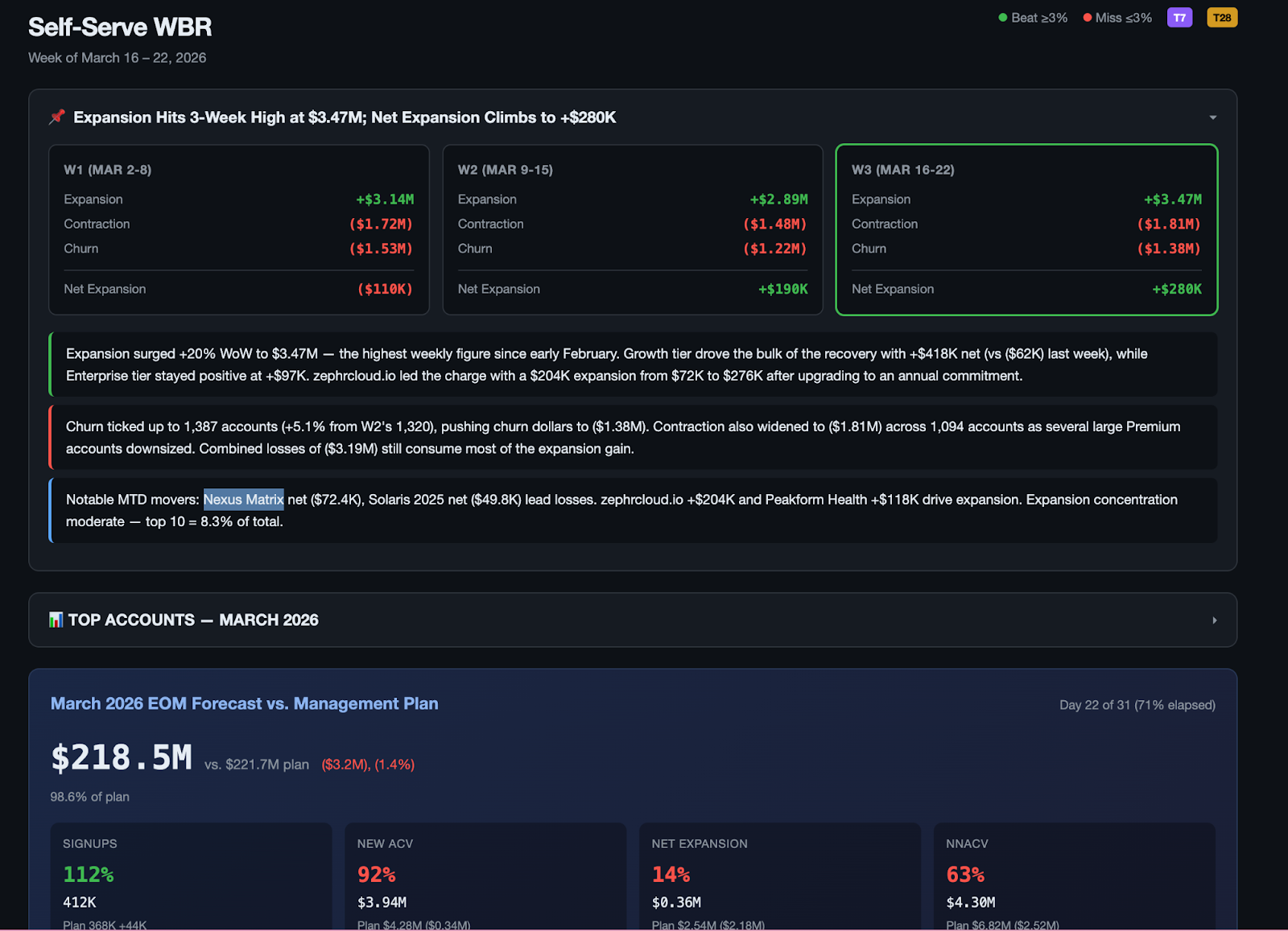
Every Monday, Airtable's FP&A team, led by Yvette Pan, shares the weekly business review (WBR) for the week: a one-page performance snapshot showing ACV movements, customer churn breakdowns, and actuals vs. plan. A formatted, interactive dashboard that anyone on the team can open and audit. It used to take us 5 hours.
Now the agent we built in Hyperagent produces it. Not a draft or a summary. The actual deliverable. In 2 minutes.
When a team member spots a discrepancy, they ask the agent:
"The net expansion numbers don't line up between the weekly and month-to-date views. Do we know why?"
The agent generates a separate tearsheet, this time by quarter, cross-references it, and identifies the discrepancy: different extrapolation methods, same underlying data. The numbers are correct. They're just calculated differently across time horizons. The team nods. They're not done.
"Remove transitions to enterprise. They'd be currently added to churn."
The agent recalculates and stores the correction in its context for future reference. The agent responds:
"This actually changes the February story quite a bit. With enterprise transitions removed, churn was 8% better than plan. The miss shifts entirely to expansion and resurrected revenue."
What looked like a churn problem was a categorization issue. The agent rebuilds the review, republishes it, and the team has a different story to tell leadership. Discovered, verified, and documented in a single Slack thread.
Before the agent, deliverables like the WBR meant pulling data from Databricks, importing it into sheets, cross-referencing targets, reformatting, building charts, checking numbers. Five hours, every Monday. Now Leroy Zhang, the strategic finance analyst who built the WBR agent, prompts it to generate the review for the week, goes to make breakfast, and by the time he's back, it's done.
The Trust Problem That Stalls Every Finance Team
Seventy-two percent of organizations have adopted AI in some capacity, but only 8% have achieved autonomous workflows in their finance functions.
The reason is straightforward. In finance, a number is either right or it's not. There's no partial credit. Finance teams are one of the most trusted voices in the room, and accuracy is a non-negotiable table stake.
There are usually ten ways to get to the same answer, and the answer depends on who's asking. Revenue can be sliced by when the deal closed or when it hits the books. A metric that's "correct" by one definition can be materially wrong by another. Which definition matters depends on who's asking and why.
Why Hyperagent Earned Airtable's Finance Team’s Trust
Connected to the source of truth
Every finance team lives across two worlds: the data warehouse where the raw numbers live, and the spreadsheets where the targets, plans, and business logic live. Some AI tools connect to one or the other. This agent needs both.
Airtable's finance agent is built on two layers. The first layer comes from the data team, which built a production data agent with access to Databricks, Looker, and Omni Analytics and business context that defines schemas, metric definitions, join patterns, and common mistakes. The finance team adopted that foundation instead of rebuilding from scratch. Because the data team built and blessed it, the finance team doesn't have to question whether the data is correct. The data agent handles the where: where to find the right tables, how to write the queries, which schemas to trust.
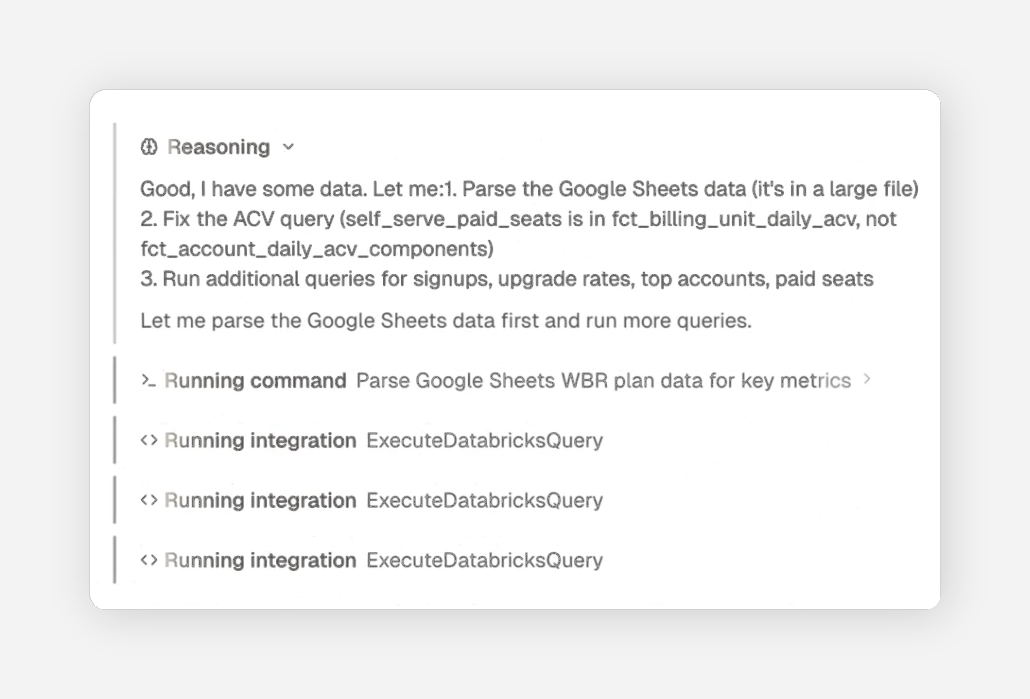
The second layer is finance-specific context. The data agent can calculate based on raw data, but it needs to know how finance calculates. What the definitions are. When the team says "churn," the agent knows the exact calculation, why it differs from how the product team defines it, and the business context it needs. For example, Airtable launched the Business SKU in Q3 of F24, so that expansion spike isn't run-rate seasonal growth.
The finance team adds this context by loading finance-specific skills they've defined in Hyperagent. These skills turn a capable data agent into a finance-specific one. The difference between an agent that can query revenue and one that knows which revenue number to pull for this week's leadership update.
Verified continuously, not once
The agent verifies every time it runs, comparing output against known baselines.
Historic numbers rarely change. The agent is told: whatever you're calculating, make sure the historical numbers match our canonical sheets and dashboards. If a historical number shifts, something is wrong.
When there are multiple paths to the same answer, the agent uses them as cross-validation. If two methods don't converge, the agent flags the discrepancy and routes it to the team for review in Slack rather than publishing a number it can't confirm. Having the agent available in Slack helps the team collaborate more and provide faster feedback for improvements.
Reliably produces trusted deliverables
The team doesn't need a text response in Slack. They need a published report with charts and commentary that goes straight to leadership.
To produce the actual WBR, the agent needed to carry the finance team's institutional knowledge, learn from feedback week over week, and execute end-to-end.
Institutional knowledge as skills. Leroy encoded the team's playbook: which metrics to pull, how to calculate them, what sources to use. Anything that goes in a job description, goes in a skill.
Memories that store history. The agent stores the rolling context — last week's format, what commentary changed, what the team flagged for adjustment. Each week builds on the last.
Integrations it can reason across. The agent pulls from Databricks for the warehouse and Google Sheets for the management plan, holds both in context, reconciles actuals against targets, builds the charts, writes the commentary, and publishes. Not separate queries stitched together — one agent reasoning across every source in a single run. For any finance team, Google Sheets is arguably the most important integration — that's where the targets and plans live.
The output is a shareable artifact: end-of-month forecast, trailing 7- and 28-day performance, weekly metrics, cohort conversion rates, tenure band breakdowns, with auto-generated commentary explaining the trends. Published to Slack, where leadership can open it, audit it, and ask follow-up questions directly.
What Stuck With Us
Trust is the actual work. The hardest part of adopting AI in finance is trusting that the numbers are 100% right. The baselines, cross-validation, and quality checks aren't paranoia. In finance, you either trust the number or you don't.
Work with your data team. The finance team didn't start from zero. They found a team that had already solved the "where's the data" problem and built on top of that work. You might not have a data agent at your company, but you almost certainly have someone who owns the data layer. Start the conversation with them. The best finance agents are cross-functional from day one.
The finance team started with a question: "Can we trust an AI agent with the numbers that go to leadership?" 10 days later, those artifacts are published every week. The WBR, the tearsheets, the MBRs. They still verify everything. They probably always will. But the hours they used to spend assembling reports are now hours spent asking better questions about what the numbers actually mean.
If you're a finance professional reading this and thinking "my team could never," consider that Yvette's team isn't a group of engineers. They're finance people who got tired of spending Monday mornings formatting spreadsheets. They started with one deliverable, one agent, and one skill. You can start the same way.
