Learning
How agents get better at your work: they propose what they picked up from a run, you accept or dismiss it, and what you keep becomes standing knowledge.
An agent starts every run with what you gave it. Learning is how it gets better than that: it notices what a run teaches and offers to keep it, and you decide what sticks.
A hundred small corrections become an agent that knows your work
Each lesson is minor on its own. A month of them is the difference between an assistant you brief every time and one that already knows the threshold, the format, and who owns the process.
How a lesson becomes knowledge
The agent works, notices a correction you made or a method that worked, and files a proposal. Nothing changes what it knows until you accept it.
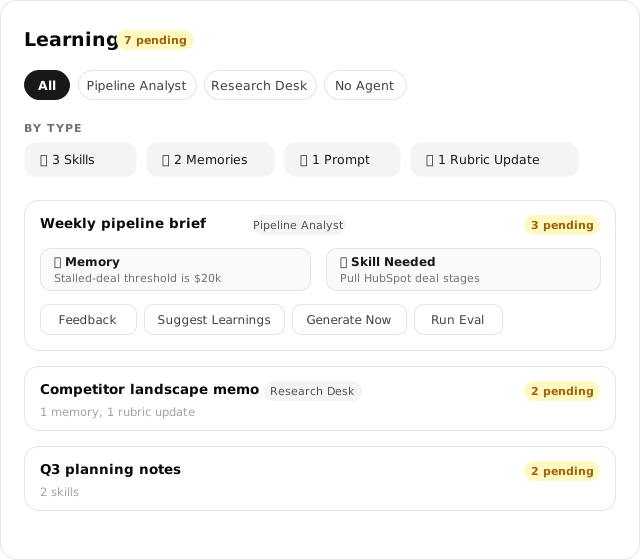
Where a proposal waits depends on how it was raised:
- Background proposals collect in the review queue, which you can reach from the thread's Learning panel, the Inbox, or the Learning page above.
- Draft cards in the chat appear when you ask an agent to reflect on a conversation, so you can edit exactly what would be saved.
- Rubric proposals go to the Rubrics page, kept separate because measuring quality is its own practice.
Each kind of learning is set per agent to Off, Suggested, or Auto-saved. Suggested is the default, so a new agent always asks first.
What an agent can learn
Memories
Facts and preferences worth carrying forward: a threshold you set, how you like a report opened. Saved as memories.
Skills
A repeatable method, like pulling the weekly report from a connected app. Saved as a skill.
Prompt updates
A refinement to the agent's instructions, added below what you wrote.
Rubrics
A definition of what good output looks like, so quality can be measured rather than argued.
An agent can also propose a change to its own configuration, which waits in the same queue.
Go deeper
Manage learning behavior
Decide how much each agent learns on its own: Off, Suggested, or Auto-saved per kind, and what always waits for you.
Manage Learnings
Review the queue, clear a backlog in bulk, and keep the knowledge you accept from going stale.
Give feedback to your agent
Teach on purpose: the feedback interview and Suggest learnings turn a reaction into knowledge the agent keeps.
Rubrics and evaluations
Define what good output looks like, score real work against it, and test a fix before you commit.
Documents and tables
Reference material an agent reads and maintains: documents for writing that grows, tables for records with typed columns, shared across threads.
Manage learning behavior
Decide how much your agent can change on its own: propose and wait for you, save without asking, or nothing at all.