Hyperagent
ConceptsAgents

Invocations

How a run starts across threads, Slack, schedules, and other triggers, and what changes when nobody is watching.

An invocation is how an agent starts a run when you are not already chatting in a thread. Someone mentions it in Slack. A schedule fires on Monday morning. A webhook arrives from your CRM.

The thread is still where the work lives. Invocations decide how the run starts and where people interact with the agent.

You do not need every invocation on day one. Most agents ship with thread chat plus one external trigger once the job is stable.

Where you can use an agent

Triggers you configure on the agent so work can begin without opening Hyperagent every time.

Each tab covers why you would use it, what it unlocks, and what to set up.

Agent Invocations page with Thread, Slack, Telegram, scheduled runs, Live Mode, and webhooks.
Configure only the ways this role should start. The thread remains the workspace for every run.

Open Hyperagent and message the agent when you are still shaping the job. You can watch tools run, correct mistakes, and save what you learn before you automate anything.

Threads keep the full workspace in front of you: assets, browsing, @mentioned skills, and the output as you refine the process.

Put the agent where your team already works when requests, escalations, and decisions already live in channels.

Why teams add Slack

  • People should not context-switch into another app just to kick off work they already discuss in-channel
  • Each agent can have its own Slack identity (for example @PipelineLead or @RevOps) so the channel knows which role is answering
  • You control what wakes the agent (@mention, topic listening, thread follow-ups) and where it may listen without posting

Slack is both an invocation and an integration. The invocation decides what wakes the agent. The integration decides whether it can read history or post a reply.

For channel agents other people can talk to, start with locked-down knowledge access so random chat does not quietly rewrite what the agent knows.

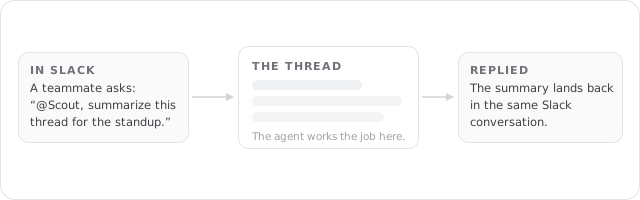
Mention an agent in Slack and keep the result in the conversation.
Identity, channels, trigger mode, bot responses, and listen-only context.

Use Telegram when the people who need the agent live on mobile or in a Telegram group more than in the Hyperagent UI.

What it unlocks: quick personal workflows from a phone, or a shared bot in a group.

Setup: pair the agent with a Telegram bot, then message it directly or add it to a group. Configure identity and who can talk to it.

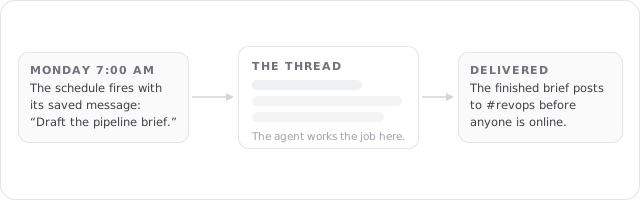
Use a schedule when the job is a predictable deliverable on a calendar. Every Monday at 7am, draft the pipeline brief and post it to #revops.

What it unlocks: recurring reports, digests, and checks that should not wait for someone to remember.

Setup: standing prompt, cadence and timezone, and whether each run starts a new thread or continues one you choose.

Filled schedule editor with name, weekly cadence, timezone, and standing prompt.
Name the recurring job, set its timezone and cadence, and give the run a complete standing prompt.

Use Live Mode when the agent should watch a changing situation, keep continuity across checks, and only bother you when something needs attention.

What it unlocks: proactive monitoring without calendar spam. Quiet "all clear" ticks can stay quiet.

Setup: checklist, interval (minimum 30 minutes), heartbeat model, where runs land, notification channel, and whether unattended runs may write externally.

Live mode dialog with interval, checklist, heartbeat model, and write permissions.
Interval, checklist, heartbeat model, where runs land, and whether unattended writes are allowed.

Use email when intake already lives in an inbox: forwards, partner updates, or "send this to the research agent."

What it unlocks: a dedicated address that turns mail into a run.

Filled email address setup with prompt template, allowed senders, attachments, and reply behavior.
Create the address, control senders and attachments, then decide whether the agent may email a reply.

Replies are not automatic

Hyperagent does not email the sender back unless you turn on reply behavior and put reply instructions in the prompt template.

If the email needs a response, draft a concise reply to the original sender.
Confirm facts from connected systems before you send. Sign as Pipeline Lead.

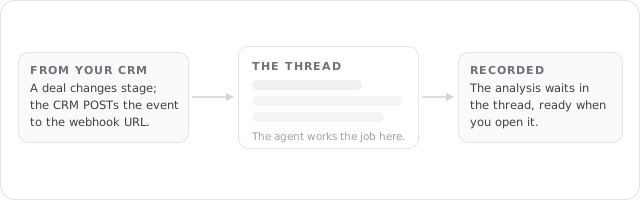
Use a webhook when another product owns the event: a CRM stage change, a form submit, a CI failure.

What it unlocks: server-side kicks with a payload and secret.

Webhook endpoint configuration for an agent.
HTTP entry point for external systems that should start a run.

Advanced

Hosted MCP is for driving Hyperagent from another client (for example Claude Desktop or Claude Code). It is not the everyday Slack or schedule path.

Hyperagent can expose a hosted MCP server so an external MCP client starts threads and sends work into your agents.

What it unlocks: use Hyperagent as a tool from an IDE or desktop client you already live in.

What it is not: a replacement for Slack, schedules, or webhooks for most teams. It does not create or update skills. Full setup and auth: MCP server.

Invoking agents with continued context

Whether later runs should see what already happened in the conversation.

Some work needs continuity. A Live Mode watch should know what it flagged yesterday. A Slack thread should keep the back-and-forth.

Other work should start clean. A Monday pipeline brief usually should not inherit last Monday's draft and side comments.

Continue

Same thread

Later runs see prior messages and artifacts. Natural fit for Live Mode, long investigations, and Slack conversations that unfold over time.

Fresh

New thread each run

Clean workspace with the schedule or webhook prompt as the main input. Natural fit for many daily reports and stateless automations.

Long threads get compacted

When a thread grows large, Hyperagent compacts older context so the run can continue. Built-in context tools try to preserve what matters, but compaction is real: a very long continued thread is not an infinite verbatim transcript. Prefer a fresh thread for clean recurring deliverables when you do not need yesterday's chatter.

Automatic invocations and unattended writes

Schedules, Live Mode, webhooks, and email often run without you in the seat.

Brief

The prompt must stand alone

Nobody is present to answer a clarifying question. Include the goal, inputs, destination, and definition of done.

Authority

Writes need explicit permission

Decide whether the unattended run stays read-only, asks outside the run, or may change a connected app.

Integration writes during unattended Live runs: Read-only or Allow writes.
Read-only vs allow writes is an explicit choice on Live Mode and schedules.

If a schedule researched correctly but never posted to Slack, check integration allow list, channel scope, unattended write setting, and the run's tool trail before rewriting the model prompt.

Setting up an external invocation on your agent

Prove the job is stable in a thread, then add one invocation.

Shape the agent in a thread

Get the prompt, tools, skills, and memories right while you can still correct the agent in real time.

Agent overview while shaping work in product.
Shape the job in product before you add external triggers.

Connect integrations, then allow them on the agent

Connect integrations at the account level, then allow them on this agent.

Tools and integrations allowed on the agent.
Connect at the account level, then allow on this agent.

Set knowledge access

Before other people can talk to the agent in Slack or a team, set knowledge access.

Knowledge controls on the agent.
Lock down knowledge before other people can talk to the agent.

Add one invocation

Pick Slack, schedule, email, webhook, Live Mode, or (advanced) MCP. Decide whether unattended runs may write externally.

Schedule setup as an example first invocation.
One clear trigger beats five half-configured ones.

Watch the first real runs

Open Activity and the threads those runs create. Fix scope, permissions, and prompt shape before you add more triggers.

Activity showing recent agent runs.
Watch the first real runs in Activity before adding more triggers.

FAQs