Models and compute
Choose from a wide model catalog and match reasoning, speed, and cost to the size of the job.
Hyperagent supports a wide range of models, from fast, efficient models for routine work to frontier models built for deep reasoning. That range lets you choose the right level of thinking for the size and stakes of the job instead of giving every agent the same model.
Match the model to the size of the job
A one-line triage check does not need the same reasoning budget as a dense research brief. Give the recurring role a sensible default, then override it when one conversation needs more depth or more speed.
Match the model to the job
Model choice changes the quality, latency, and cost of every run. Start with the work the agent owns, then choose enough capability to do that work reliably.
Routine, frequent work
Classification, formatting, extraction, and simple recurring checks reward speed and a lower cost per run.
Everyday agent work
Research, drafting, analysis, and multi-step tool use need dependable judgment without paying for the strongest model on every turn.
Large or consequential jobs
Ambiguous research, difficult strategy, complex debugging, and external final work benefit from a frontier model and more reasoning effort.
Where you choose a model
The same model choice appears in four places. Choose the surface that matches the scope you want to change.
Model and limits
Sets the agent's default model, runtime, subagent model, turn timeout, and auto-compact threshold for new work.
Header model chip
Changes the model for the current conversation without changing the named agent's default.
Model & compute
Holds the same thread override beside Fast inference and Reasoning effort, so the model and its compute controls stay together.
Agent defaults
Sets the model a home thread starts on when no agent is bound. Open Agent defaults to change it.
Set the usual model, change it when needed
The model saved on an agent is the starting point for its work. You can change the model for one conversation without changing what the agent uses everywhere else.
The usual model for new threads
Choose the model that fits the role's recurring work. Every new thread on that agent starts with this model unless you change it inside the thread.
A different model for this conversation
Change the model from the thread header or Model & compute. That thread keeps the new choice; the agent's usual model and its other threads stay unchanged.
A home thread that is not connected to a named agent starts with your Agent defaults. Once any thread begins using a model, changing the agent's usual model does not rewrite that existing conversation.
Latest aliases and pinned versions
The picker opens in two sections, and which one you choose decides whether the agent moves with upgrades or stays put.
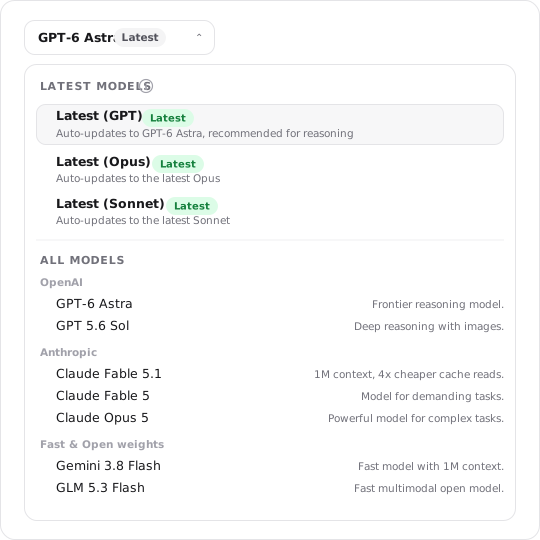
Latest models
Maintained aliases such as Latest (Opus) or Latest (GPT) that track the newest version in a family. Pick one and the agent receives the family's normal upgrades with no configuration change. Hover the section for the note: We'll automatically use the latest model in the selected family when you create a new thread.
All models
Pinned numbered versions, grouped by provider. Pick a pin when you need repeatability, such as an evaluation or a controlled comparison, and the model stays exactly where you set it until you change it.
When an alias is selected, the model chip carries a Latest badge. Experimental models carry an Experimental badge, with the tooltip Early access, behavior and availability may change.
Supported model catalog
Hyperagent supports models from several labs, so you can match the model to the agent's job instead of rebuilding the agent around one provider. The catalog changes as models are validated; the picker is the source of truth for what is available to your account.
Anthropic
| Model | Best fit | Context |
|---|---|---|
| Fable 5.1 | Sustained multi-turn workflows, long planning, and 4x cheaper cache reads | 1M |
| Fable 5 | Highest-capability work when quality matters more than cost | 1M |
| Opus 5 | Complex agents, difficult reasoning, and careful final output | 1M |
| Opus 4.8 | Earlier flagship for complex work; supports Fast inference | 1M |
| Opus 4.7 | Earlier Opus model for complex work | 1M |
| Opus 4.6 | Earlier Opus model for complex work | 1M |
| Sonnet 5 | Balanced everyday agents at lower cost than Opus | 1M |
| Sonnet 4.6 | Earlier balanced Sonnet model for everyday work | 1M |
| Haiku 4.5 | Quick, simple tasks and high-volume lightweight work | 200K |
OpenAI and Google
| Model | Best fit | Context |
|---|---|---|
| GPT-6 Astra | OpenAI's frontier reasoning model for complex agentic analysis | 950K |
| GPT 5.6 Sol | Deep reasoning model with image support | 950K |
| GPT 5.6 Terra | Balanced OpenAI option for everyday agents | 950K |
| GPT 5.6 Luna | Fast, low-cost OpenAI option | 950K |
| GPT 5.5 | Earlier OpenAI flagship | 950K |
| Gemini 3.8 Flash | High-throughput, fast Google model with 1M context | 1M |
| Gemini 3.6 Flash | Fast structured execution, monitoring, research loops, and coding | 1M |
| Gemini 3.5 Flash | Earlier fast Google model for everyday work | 1M |
Open and specialist models
| Model | Best fit | Context |
|---|---|---|
| GLM 5.3 Flash | Fast multimodal open model for coding and agentic work | 900K |
| GLM 5.2 | Low-cost everyday agent work | 1M |
| GLM 5.2 Fast | Faster GLM output for high-volume work | 1M |
| Kimi K3 | Moonshot's highest-capability open model | 900K |
| Kimi K3 Fast | Faster Kimi K3 output when latency matters | 900K |
| Kimi K2.6 | Low-cost everyday work on an open model | 230K |
| Qwen 3.8 Max | Frontier coding, research, and long-horizon work | 1M |
| Qwen 3.7 Plus | Cost-aware general work and coding | 230K |
| DeepSeek V4 Flash | High-volume coding and tool work at the lowest cost | 1M |
| DeepSeek V4 Pro | Deep reasoning on an open model | 1M |
| MiniMax M3 | Low-cost search and synthesis across a large internal knowledge base | 1M |
| Fugu Ultra | Coordinated expert-agent work on complex tasks | 1M |
| Grok 4.6 | Longer research and analysis that ends in a decision-ready brief | 500K |
| Grok 4.5 | Conversational agent work | 500K |
| Muse Spark 1.1 | Creative agent work | 1M |
| Inkling | Compact, low-cost open-model work | 230K |
If a model you need is missing, share both the model and the job you want it to perform with the Hyperagent team. The use case helps the team evaluate quality, runtime compatibility, and demand.
Model & compute controls
Inside a thread, Model & compute gathers the model and the two dials that shape how it runs. Reasoning effort decides how hard the model thinks; Fast inference trades cost for speed on the models that support it.
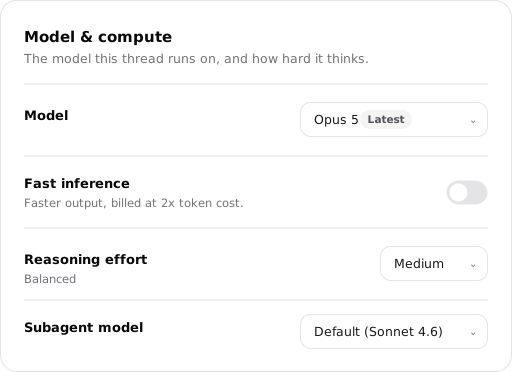
Reasoning effort
Reasoning effort sets how much thinking a model does before it answers. More effort buys deeper reasoning on hard problems; less effort returns faster and costs less. The default is Medium, shown as Balanced.
| Level | Reads as |
|---|---|
| Low | Fast responses |
| Medium | Balanced |
| High | Deep reasoning |
| Extra high | Deeper reasoning |
| Max | Maximum capacity |
Reasoning controls depend on the model
Each model shows only the effort levels it supports, so its picker may contain a subset of these five. When a model has no configurable reasoning, the effort picker does not appear.
Fast inference
Fast inference runs an eligible model at higher throughput. Its helper text states the tradeoff plainly: Faster output, billed at 2x token cost. Reach for it on interactive replies and tight loops where latency matters, and leave it off for deep analysis and final writing where standard speed is the better fit.
The toggle appears only on the models that expose it, currently Opus 4.8 and Opus 5. If you don't see the toggle on the model you're using, that model doesn't offer Fast inference in Hyperagent.
Subagent model
Subagents are short-lived workers a run spins up to handle parallel legwork on its own. Subagent model sets the default model those workers use.
Sonnet
Balanced capability and cost. The default subagent model, shown as Default (Sonnet 4.6).
Opus
Frontier reasoning for delegated work that needs the strongest model.
Haiku
Fastest and lowest cost, for high-volume lightweight legwork.
Parent model
Match the parent agent's own model instead of a fixed tier.
Runtime
The Runtime control on the agent's Model and limits card decides which execution runtime serves the model. It defaults to Default chooses the runtime from the selected model, which is the right setting unless you have a specific reason to change it.
Turn timeout
Turn timeout caps how long one turn may keep running. It applies to the current turn, not the lifetime of the thread: later turns can continue in the same conversation.
Use a longer timeout for deep research, browser work, coding, or other jobs that may need sustained tool use. A shorter timeout gives routine or unattended work a firmer stop. If the limit is reached, Hyperagent ends that turn rather than letting it run indefinitely, and the thread keeps the record of where it stopped.
Auto-compact threshold
Every model has a finite context window. Auto-compact threshold decides how full a thread's active context may become before Hyperagent compacts it automatically. Compaction summarizes older conversation so the agent has room to continue; it does not remove the transcript from the thread.
A lower threshold compacts sooner and leaves more headroom for upcoming work. A higher threshold keeps more of the raw conversation active before compacting. For a one-time compaction, open the model menu in the thread and choose Compact context now, or enter /compact.
The thread's Thread Context Document survives compaction and keeps the facts, corrections, decisions, and plan tasks the agent recorded for the current job. See how a thread keeps working context.
Live Mode model
Live Mode runs each scheduled check on its own heartbeat model, chosen separately from the thread and defaulting to the latest Sonnet. This lets a frequent check use a faster, less expensive model without changing the model used for the agent's other work.
When a model becomes unavailable
If a model is removed from your account, it leaves the picker and any new run that resolves to it errors with not available for your account. Latest aliases migrate gracefully: when a family is retired behind an alias, stored selections resolve to the model now serving that family, and the thread shows the model actually in use.
FAQs
Activity
The agent's own thread history: every run it has done, live and interactive alike, with search and filters, each row opening the thread behind it.
Knowledge access
What an agent can reach and where its new knowledge is saved: read scope, attachment and discovery, save destination, knowledge profiles, and what changes in a workspace.